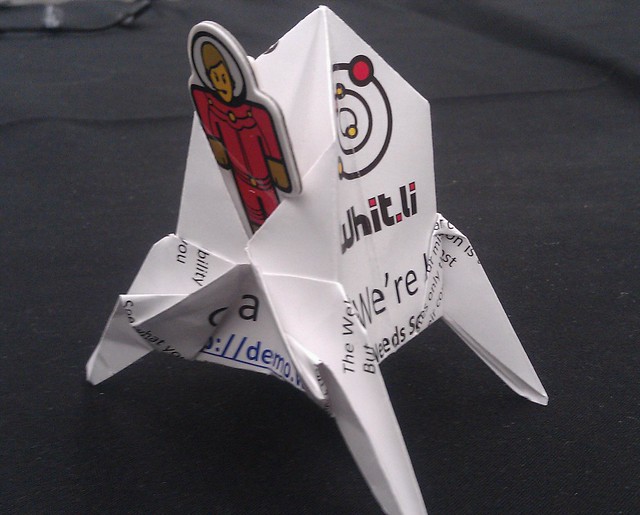
Subway Etiquette

Sometimes I wonder about subway etiquette.

The other day I was on a train and noticed a man wearing an Autobots T-shirt. I poked Harold, with an attempt at subtlety, and pointed out the real-life counterpart to a Hasbro virtual-goods promotion we’d worked on for Next Island. I pointed out the three colorable fields, one of the attributes that caused difficulties, as if I could retroactively prove its desirability to players, and retroactively get back those hours arguing about it.

Exhibit A: Pretend Transformers Shirt

I’m not entirely sure why I want to snap a picture of the passenger in the Autobots shirt, it’s not actually my project and I can’t actually gather visual evidence to defend my argument last year, but I sort of do want a picture.  Is that weird? It seems strange, even invasive, but it seems just as artificial to maintain the usual subway commute fiction that no one else exists. We travel together in tiny boxes, shoulder-to-shoulder sometimes, refusing to make eye contact, and hoping no one break the the rules, and forces us to acknowledge another person. So, should I try to take the photo, while pretending to text, and he can follow the subway etiquette of ignoring fellow passengers? But what if he breaks it?

Can I tell him I worked on a project making virtual versions of the t-shirt  he’s wearing? Could I set up the camera, hold it in readiness, and then snap as I’m getting out of the subway?

There’s a commotion next to me, as I’m wondering whether I should take a video and look for a still later.  A couple near me is trying to see the cover of a tabloid that a man’s got folded under his arm, and after trying to get a decent view of it, they finally ask him for a look at the paper.

It’s one of the city’s daily rags, and the cover is a sensationalist news photo of a young girl, with bloodstained hands and an all-caps headline, standing in from of a yellow-taped crime scene.

“It is!” the wife says triumphantly. “That is the building next door to us!”

Like I said, I don’t always understand the rules of subway behavior.

Posted in New York City | Tagged , , , , | Leave a comment

Words With Friends, GChatting Edition

Roy: Why is the Muppet show theme song stuck in my head now?

Meg: because it’s time to play the music?
it’s time to light the lights?

Posted in New York City | Tagged | Leave a comment

This American Life

Listening to This American Life is usually a solitary activity.  I started listening to TAL regularly when I lived in North Carolina, and I was convinced that Ira Glass was sending dispatches from the urban world directly to me (and to Stick), reminding me that I was not actually Ovid in exile on the Black Sea. Now I usually listen to podcasts on headphones while I work, but it’s still solitary.

Last week, I went to the This American Life show with Harold, Roy, and Roy’s friend Simone, who all listen to TAL independently, and we sat down in a theater full of NPR hipsters, watching the show simultaneously with other theaters full of NPR listeners all over the country. A massive network of people laughing at the Terri Gross bank robbery, or at the RadioLab random numbers, or watching at the street portraits or dances just for the live audience, and listening to more typical TAL segments of audio blog posts and the obligatory David Sedaris reading.

And Ira Glass gave asked everyone to download the TAL Live app, which had three buttons to create three sounds, and appeared magically in different colors on different phones. We were asked to turn our phone volumes all the way up, and reminded several times that ordinarily one should never use a cell phone in a movie theater. Each player would watch the feed for icons of his color, and hit the corresponding button on his phone on the cue. Players without smartphones would be the rhythm section, snapping and stomping. (Audience members were not reminded that ordinarily, one should not stomp and snapping in a movie theater.) Then OK GO came on to play a song, with the accompaniment of that entire massive network of NPR hipsters.

If I had known that play massively multiplayer Cell Phone Hero with Ira Glass and OK GO was a thing to put on a life list, I would have put it on my life list.

Posted in New York City | Tagged , | Leave a comment

Look, A Three-Headed Monkey!

I’ve recently learned that it’s actually much harder to work How appropriate, you fight like a cow. into the dialogue for a tropical island game than Monkey Island might lead one to believe. Just in case you were wondering.

Posted in virtual life | Tagged , , , | 2 Comments

(I Attack The Darkness)

Meg: Hi, *New beta tester*, was *endless grind assignment* the least fun you’ve ever had playing a videogame?

New Beta Tester: No. Yesterday Caitlin had me swimming underwater to take pictures of the darkness.

Posted in New York City | Tagged | Leave a comment

Sunshine Challenged

I ended up with my apartment in Bed-Stuy because it was close to the train to my office work, walking distance to Harold and to Roy, and near lots and lots of hipster coffeeshops, but my bedroom happens to have a skylight. It’s a walk-up, without a dishwasher, and the laundry is down the street, and my room is just barely big enough for my bed and my clothes, but there’s a gorgeous skylight over my bed.

As the days get lighter, I’ve begun waking up earlier. You’d think this is going to be a delightful story about waking up in the middle of the city, with sunshine on my face, but actually, I wake up in a panic that it’s so bright, it must be late, I must have slept through my alarm! And I leap out of bed in panic. Every day.

These bright spring mornings are totally overrated.


Posted in New York City | Tagged , , | 3 Comments

Kuala Lumpur

The following is probably only funny to my college friends, but it proves that I’m not the only one who waits years for the perfect chance to say something ridiculous. Eric does too!

Meg: Remember when you poured iced tea into my lap twelve years ago?
Eric: Yes. You haven’t let me forget it.
Meg: I totally one-upped you the other night.
I set Harold’s napkin on fire at dinner.
Eric: Oh did you…
Cool, now you can lay off about the tea.
Meg: it was all his fault, really.
Eric: If he hadn’t been cleaning the dishes with lighter fluid, the napkin would have been fine?
Meg: haha no, I was distracted,
which is clearly his fault!
Eric: I see. Surely he knows better then to distract you when there’s fire nearby
Or sharp objects, fragile heirlooms, steep hills/cliffs, water, hamsters, budgies, carrots, handbags, cheese, kuala lumpur

It also proves that I should probably not be trusted in restaurants with candles.

Posted in New York City, Western Mass | Tagged , | Leave a comment

Thoughts on Michael Saladino’s GDC Talk “Wake up! Your Team is on Fire! Why Your Real Problems Are Cultural and How To Change Them”

A common metaphor we all hear in game development, and software development in general, is fire. After an absence, we ask our team what’s on fire. We talk about projects that are on fire, we refer to fighting fires as we try to solve development problems in the face of release deadlines. I’m personally guilty of this, I triage my tasks into what’s most on fire to solve first, and I use those very words when I do so.

Michael Saladino believes this disaster metaphor is a symptom of a lack of understanding the problems in game development. Smart studios should work to give up the disaster metaphors, and start viewing problems like treating cancer. In this model, problems in development should be addressed as symptoms of a larger problem.

The fire is not, say, a looming and impossible milestone, but a symptom of a systems failure. That milestone that’s giving the team such a problem didn’t occur in a vacuum, so is the cause a poor management call? A team too small for the workload? Ineffective software? Wildly differing expectations from different departments?

Smaller problems will point to the root cause, but unfortunately, these low-level problems are often ignored. Whether it’s a too-small team, poor management, flawed software, or dozens of other systemic challenges, this root cause will continue to result in low productivity.

Good crunch is when the team orders pizza into the office, and stay late completing tasks and hitting a deadline. In good crunch, meeting a deadline is a motivator. The dev team all want to hit milestones and hit ship dates, and they’re ready and willing to stay late to make that happen.

Bad crunch is when the entire team works evenings and Saturdays, spends Sundays trying  to sleep off some of their exhaustion, and drag themselves in on Monday to do it all over again. Bad crunch is sustained. Employees burn out, leaving the games industry or at least the company.  (For anyone who may be unfamiliar with it, I’d like to point you to Erin Hoffman’s 2004 “EA Spouse” essay on the state of crunch and the development lifestyle. And in the tech world, Facebook’s Sheryl Sandburg just made headlines for announcing that she leaves work early — at 5:30 — every day to be with her family.)  Often a crunch schedule’s long hours are instituted by the company, when management calls in the employees’ promised dedication to work, in order to ship a product on time.
Saladino points out that when faced with difficult goals, many employees start their own crunch time. When an employee feels that his deadlines are impossible, that he’s hitting a low percentage of his goals, that he’s being pulled in too many directions, or whatever the flag is that his work is slipping away, employees will stay later and create their own crunch schedule.

This is caused by people who are dedicated to the job and the product, facing impossible deadlines. Saladino doesn’t actually spell this out, but I believe that this self-imposed crunch comes out of employees who are committed to the game and to the games industry. Otherwise, why not be out the door at 5:01 PM?  That same motivation and the same work ethic that causes good crunch and higher productivity also creates the productivity drain of long hours.

Saladino refers to his thesis that bad crunch is a symptom of a systemic illness, and to eliminate this symptom, a good studio needs to diagnose and cure the root cause. To this end, he suggests many ways to clear up communication and process, and to set and achieve reasonable milestones.

Good advice for an industry known for long hours and early burnout, but it will be interesting to see how many studios can take the time from firefighting to remodel the development process.

Posted in New York City | Tagged , , | Leave a comment

Protecting The Finnish

I’m on a Skype call for work, meeting long-distance with co-workers based in Manhattan and in Gothenburg. One of the guys has just told us a Swedish joke, and then asked if anyone else knows a good joke about Swedes. Or possibly a joke at the expense of Norwegians? Scandinavians? Sadly, the Americans don’t have much to add here, and that brief moment of camaraderie is about to sink back in to the swamp of misplaced emails and impossible deadlines.

Then, I remember that I do know a good Scandinavian joke! I’ve been waiting years for the perfect opportunity to tell my sister’s best joke!

“Hey, guys!” I say, “I’ve got one! Why do they polish the tanks in Helsinki everyday?”

I was very happy, it’s been a long time since I got to use Bethie’s joke about protecting the Finnish. The last time it was really appropriate in everyday life, I was on a mad rush to the American Embassy in Beijing. True story.

Posted in New York City | Tagged | 9 Comments

Daredevil

Stick asked me the other night where if my sister Bethie picked a grad school yet.

“She did!” I tell him. “She’s going to Columbia! She’s going to live in the city, near me!”

“Columbia? That’s a great choice!” Stick says, “because that’s where Daredevil went to school!”


Posted in New York City | Tagged , , , , | Leave a comment