
Instagrammar – (n.) Communication entirely or largely through hashtagged words.
Usage: Check out my #new #word Instagrammar! #OED #Dictionary2.0 #improvingtheEnglishlanguage #WOTD
Instagrammar – (n.) Communication entirely or largely through hashtagged words.
Usage: Check out my #new #word Instagrammar! #OED #Dictionary2.0 #improvingtheEnglishlanguage #WOTD
Recent story on OpenSource about my work:
Youth Digital just moved into their new offices, tucked away in a nondescript office park in Chapel Hill, North Carolina. It’s a big step up from their humble beginnings, when company founder and director Justin Richards hauled a laptop to his students’ houses, tutoring them on web and graphic design. Their first office was barely more than a closet, and now they have an expansive space complete with conference rooms, recording studio space, and their own 3D printer.
Teaching kids about graphic design and programming without using open source software would be prohibitively expensive. As I learned during my visit to the studio’s new office, cost isn’t the only reason why Richards and his team use open source tools. The freedom of creating custom application packages for their students and the opportunity to improve the software that they use means that everyone learns with the same easy-to-use technology. It doesn’t matter whether they’re sitting in a classroom in Chapel Hill or tuning in to Youth Digital’s online courses halfway around the world.
 One of my best discoveries at Richmond Comic Con.

Walking Thumbs’ new Blabcake Messenger App lets users chat with their friends using expressive animations and cute interactions. This social app is often described as emoji chat, but actually users have cute berry avatars. Individual Berries can be personalized with color, hair and mood, and they can be customized by adding clothes and accessories, so each Berry is unique.

Avatar customization with Blabcake’s Berry
Chatters can animate their berries, with a variety of actions, from emotional reactions (a broken heart, a sleepy face, or an angry scowl, among others) Users can interact with the friends’ Berries too, by sending them hugs, blowing flower petals, smiling at each other, or other friendly interactions. Or turning their friends into animals or cupcakes, whatever. They can express not-so-friendly emotions too, but even the table-flipping sequence is pretty cute.

Obviously this is what I would look like as a Berry.
The app is geared for tweens and young teens, and with so many cute sunglasses and hairstyles, it’s clear that BlabCake is primarily aimed at girls in this age range. But did you notice that the logo is not pink? Yeah, it’s not pink!
Like any social app, it’s only as safe as the chatters using it. I mean, tweens COULD be talking about overthrowing the government next to their adorable lil Berry avatars. But the provided content in the app, the accessories and animations, is fun and tween appropriate.
Walking Thumbs’ new Blabcake Messenger App is available free for iOs and for Android mobile devices. And, it’s actually free, since users can use wifi instead of data or SMS. The app doesn’t yet have any premium blabbery yet, but I think it’s safe to guess that the app will monetize on paid upgrades of premium adorable blab art, like seasonal decorations and Berry accessories.
 Finally, the logo for Blabcake is not pink. Yes, it’s entirely possible to make something cute and tweeny without defaulting to Mattel pink. I mean, I knew that I had strong feelings about this, but didn’t realize just how much I was predisposed to like this app simply because the logo and branding wasn’t pink. Blabcake is an example of brand art for a tween-girl targeted product that is unashamedly cute and sweet, without falling into the usual pink-it-and-shrink-it trap.
Features:
This post is brought to you in partnership with Walking Thumbs, because I am an expert on cuteness and on making apps for girls without pink logos.
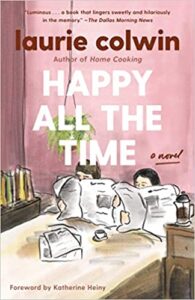

The novel is all about people interacting with each other. There’s almost no tension in this book, mostly we watch people going about their lives and making the sort of minor choices that lead to larger outcomes, and understanding or misunderstanding each other. The tone reminded me of a Maeve Binchy novel, if all the characters were wealthy Manhattanites, that is.
I love stories about developed characters and personal relationships, and in this novel, there was almost no plot to distract from the personalities in the book. Instead of tension and drama with manufactured arguments and reconciliations, this was just a gentle rumination on why we fall for the people we love, and how relationships grow and change.
I received a copy of this book from the publisher to review.
“Have you ever taken it, sir?” asked Michael Corner with great interest.
“Twice in my life,” said Slughorn. “Once when I was twenty-four, once when I was fifty-seven. Two tablespoonfuls taken with breakfast. Two perfect days.”
We’re hiring a new summer camp director at work, and he was being introduced around, and asking what everyone does, and when it came to me, I said I teach app design in the studio, I work with our online students creating and curating game and tech news for our internal community, and I work with our parent community on social media, which means creating content, amplifying positive user-generated content and minimizing any negative feedback.
And when I finished saying that, I was thinking, YEAH, that is exactly what I should be doing! And I seriously haven’t felt like this since, I don’t know, maybe at Next Island before some of the complete craziness went down? I’m doing good things! interesting things! that have meaning! and things I am good at doing! and things that match who I really am on the inside!
I felt really happy and I want to remember this and what it feels like to be contented and happy, instead of realizing later, oh I really liked writing for that outlet or that team used to be really good. I tend to only really recognize a good situation in retrospect.
And then I left work early to work on editing essays for Checkpoint, and I’ve gotten such good pieces, and the ratio of mass-mailed form letters and mistargeted garbage to thoughtful essays is finally tipping the way I want. And some of these pieces are from friends that I’m just delighted to work with again, and some are from strangers so I didn’t even have to beg them for submissions. So, there’s that.
I was pretty tired (I’ve not been sleeping terribly well recently, and I am not great at life when I need rest), so I was considering just heading home to bed, but I didn’t want to miss the game theory after hours at the science museum in Durham. This is more like something I’d do in Brooklyn, and seriously going out is much harder here where everything involves driving and navigating and parking, and, oh, let’s be honest, once I figure out how to get to whatever event, it’s kind of a sad mini-version of what I miss in New York, which is terribly depressing and makes me wish I’d stayed in with a book.
Not this time! We went to the science museum after closing, and joined all the other adults drinking beers and playing with the science museum exhibits and game demos all around the exhibit halls. It reminded me of IndieCade East last year, and I mean the interactive museum space and playful spirit and the crowd in general, not the part where that blizzard kept half the attendees away.
Then Harold and I got PBRs and went to a science classroom for a lecture on game theory. The professor used really clear examples where it was all arithmetic you could do in your head to follow the principles, and there were a couple of demo games to illustrate points, including Two Card Poker (from a custom-made Women In STEM deck, naturally) and a game where you try to guess two-thirds of the average of everyone’s guess. I’m a level 2.5 reasoner, which is, a level 2 reasoning plus a little variance for the Fabrice Effect. I mean, it was a self-selecting group of people who wanted to go to a game theory lesson, so there probably wouldn’t be that one friend who doesn’t quite get it, but on the other hand, PBR was $2.
I looked down at my two cards, and the plastic denarii for betting, and my PBR, and I actually felt good. Oh, ok this was worth driving around Durham. This isn’t a sad little version of a Brooklyn evening, this is a pretty nice time anywhere.
Then I went home and slept a good sleep.

Two-Card Poker, Denarii, and PBR
 We meet again, my old enemy.

(Speaking of that essay: When the author makes the faux-concession statement that those high culture / low culture thinkpieces require, about how at least this plebby non-literature is getting the uncultured masses to open a book, the author name-drops a TV show. Slate thoughtfully links the Amazon page where readers can immediately purchase it. With an affiliate link. Hilarious.)
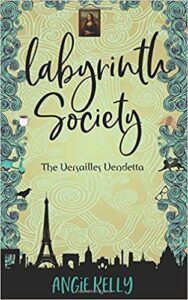
Labyrinth Society: The Versailles Vendetta
Female-authored fiction for a young, female audience is often disparaged by calling the characters all Mary Sues. (Among other ways, I mean, like calling them beach reads and airport novels, and other things that mean well, if you have the time to waste, I guess you can enjoy it. Oops, got sidetracked, this isn’t a post on all the ways that novels written by women for the enjoyment of primarily women get downplayed!) Mary Sues have something to do with wish fulfillment, they’re too awesome, their dialogue is too snappy and their luck is too good, like we don’t all read books to see interesting characters doing exciting things.
This is a short novel about three adopted girls, who live in a mansion full of exotic, and usually enchanted, relics that their foster mother, a strangely ageless archaeologist, has collected. They travel through time rescuing historical artifacts, usually racing against unscrupulous antiquities dealers. Also there is an handsome British groundskeeper, loads of secrets, magic time-travel jewelry, and also a pair of glitter Chucks. It it exactly the kind of story I would dream up when I was supposed to be paying attention in middle-school classes, and I mean that in the best way.
Sure, there’s a lot of time-traveling escapism, but at the same time, the novel’s about chosen family and female friendships, telling the story of a prickly third foster-daughter joining a home that’s both a great deal happier than her previous houses but also so full of secrets. And instead of one female sidekick along on the typical adventure team, we have three girls with different personalities working together to save history.
Read it for yourself, if you’re intrigued by magical teenager historians, and a teen novels without the obligatory love triangle, or just to be the coolest Auntie or Uncle to the middle-school girl in your life.
I received a copy of Labyrinth Society: The Versailles Vendetta
Starting to work on this collection has been constantly surprising me.
I want to post, with modest amazement, about all the talent I’ll get to work with, which is something I always jealously read editors posting, but mostly I’m angrily amazed at the weirdly mis-targeted resumes I’m getting. I mean, I’m not asking for resumes at all, but sure, send it along if you think it’s important.
I definitely wasn’t expecting all the generic form letters applying for writing gigs (First place to the guy who said he was inspired to apply for POSITION because of COMPANY’s outstanding reputation in the industry.), and I’m not entirely sure that everyone who applied had read the posting. There are a lot of Dear Sir letters, or promises of SEO-friendly articles on any keyword. I mean, it’s not like I’ve even offering a lot of money, where it would make sense to apply even
There are people who submit work, and email angrily a few hours later to ask why I’ve not responded yet, and some who seek out my personal email because their question is too important to go to the inbox I’ve set up for this project. The whole thing is terribly confusing for my impostor syndrome, dealing with entitlement as a potential editor, when I tend to approach all opportunities nervously. Is this for me? Am I any good at this? Am I wasting everyone’s time with my silly questions? So it’s definitely a learning experience for me.
Anyway, right now I have four pieces that are delightful and amazing and I can’t wait to share them with you, and a few more in the process of editing. I also have about a hundred SEO-optimized pieces on generalized gaming, and a thousand spun articles with gaming-related keywords, so there’s that.

Getting ready to film. (Not pictured: Coffee, my awesome coworkers, more coffee, and many, many rounds of script edits)


